SHAWN COLE

Fifteen-plus years across service design, strategy, research, and product. I’ve led work with real, measurable outcomes in automotive, consumer electronics, financial services, e-commerce, and early-stage ventures, always at the intersection of how organizations operate and how people actually experience the result.
I’m currently working on what’s next!
WORK & THINGS
| What | Context | When |
|---|---|---|
| Youth are getting creative to compete in a token-driven job market | Futures Scenario · 20260610 Futures Scenario | 20260610 |
| A DAW filter plugin that routes audio through a dot fabric | DAW Plugin & Web Demo · 20260610 DAW Plugin & Web Demo | 20260610 |
| Generative tool for creating dot fabric patterns | Javascript Tool · 20260608 Javascript Tool | 20260608 |
| What's really wrong with AI adoption in the enterprise | AI Enablement · 20260601 AI Enablement | 20260601 |
| Redesigning the end-to-end loan origination process for a new use of an old product | HomeEquity Bank · 20241001 HomeEquity Bank | 20241001 |
| How to jumpstart forward-thinking cultures before disruption forces your hand | Strategic Foresight · 20240903 Strategic Foresight | 20240903 |
| Design leadership at a venture studio focused on enterprise AI and financial services | Koru · 20230731 Koru | 20230731 |
| Research into the commercial automotive aftermarket for Ford's CTO | Ford Pro · 20220422 Ford Pro | 20220422 |
| Designing the industry's missing spatial computing operating system | Global Tech Company · 20210601 Global Tech Company | 20210601 |
| Behavioural architecture for Huawei's in-car AI agent | Huawei · 20200414 Huawei | 20200414 |
| Co-founded a strategy, design, and futures advisory | Humanistic · 20180201 Humanistic | 20180201 |
| Product design at an early-stage video platform startup | Helpful · 20160201 Helpful | 20160201 |
| Service design for retail and commercial property management | Kinetic Café · 20140301 Kinetic Café | 20140301 |
| Mobile design consulting across iOS and Android client projects | Xtreme/Pivotal Labs · 20130301 Xtreme/Pivotal Labs | 20130301 |
Driving is emotional, even though it shouldn’t be
The task ahead of us wasn’t really go find how this robot should act, but selecting an emotional model the system would be informed by. I evaluated three families of emotion theory: 2D models (Russell’s circumplex), 3D models (Plutchik’s wheel, Ekman’s basic emotions), and the Cognitive Structure of Emotion (Ortony, Clore, and Collins). The 3D models offered richer expressive range but introduced detection ambiguity that the in-car sensing technology couldn’t reliably utilize. We chose Russell’s valence-arousal model because it provided a reliable perceptual foundation for both humans and machines, with enough granularity to distinguish eight sub-emotional states (happy, astonished, alarmed, frustrated, sad, bored, relaxed, satisfied) within four high-level quadrants.
Next… what should the agent should say? I drew on micro-sociology, specifically Erving Goffman’s social exchange theory, and broke all possible agent interactions into four branches: Exchange (rapport-building small talk), Cooperation (emotional, tangible, informational, and companionship support), Competition (games, challenges, activities), and Conflict (alerts, warnings, errors). Within the Exchange branch, I adapted Demarais and White’s framework of four “social gifts” for building rapport: Appreciation, Connection, Enlightenment, and Elevation. Each of these became a structured response category the system could draw from based on the current context.
I also researched how people form long-term relationships with machines. MIT’s work on Relational AI, which studied how children build social connections with robots, was particularly useful. It introduced the spectrum between transactional interactions (pure utility) and relational interactions (social connection, rapport, shared narrative), and showed that the strongest human-agent bonds developed when the system could move along that spectrum over time. I designed the framework’s relationship class model around how the system tracks interaction direction, frequency, recency, and total relationship length to classify whether the bond is weak-transactional, strong-relational, or somewhere in between, and adapts its response style accordingly. Essentially,
Hello, SARA
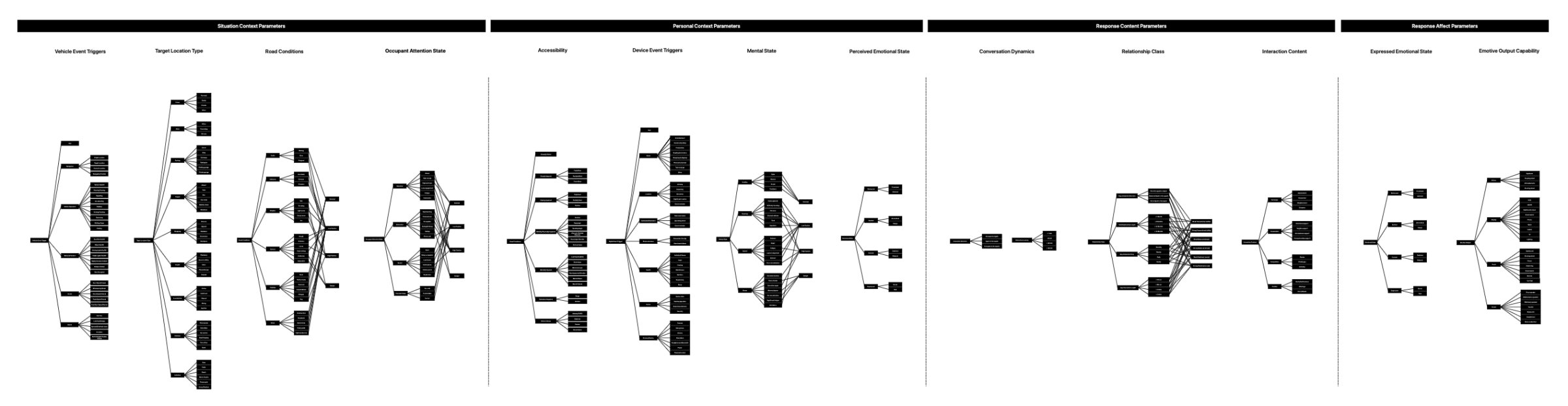
All of this research fed into the core deliverable, a Social Agent Response Architecture (SARA). It’s a four-layer system. The first layer captures situation context (vehicle events, target location, road conditions, occupant attention state). The second captures personal context (accessibility needs, device event triggers, mental state, perceived emotional state). The third determines response content (conversation dynamics, relationship class, interaction type). The fourth filters the response through appropriate emotional affect and maps it to available output channels (motion, display, sound, haptics). Each layer has dozens of enumerated parameters with explicit connections to the layers upstream and downstream.
We built the architecture to work across domains by swapping the situation context layer. For automotive, the parameters cover vehicle operation, road conditions, and distraction states. For education, they cover learning devices, location types, environmental conditions, and attention states. The personal context, response content, and response affect layers remain shared.
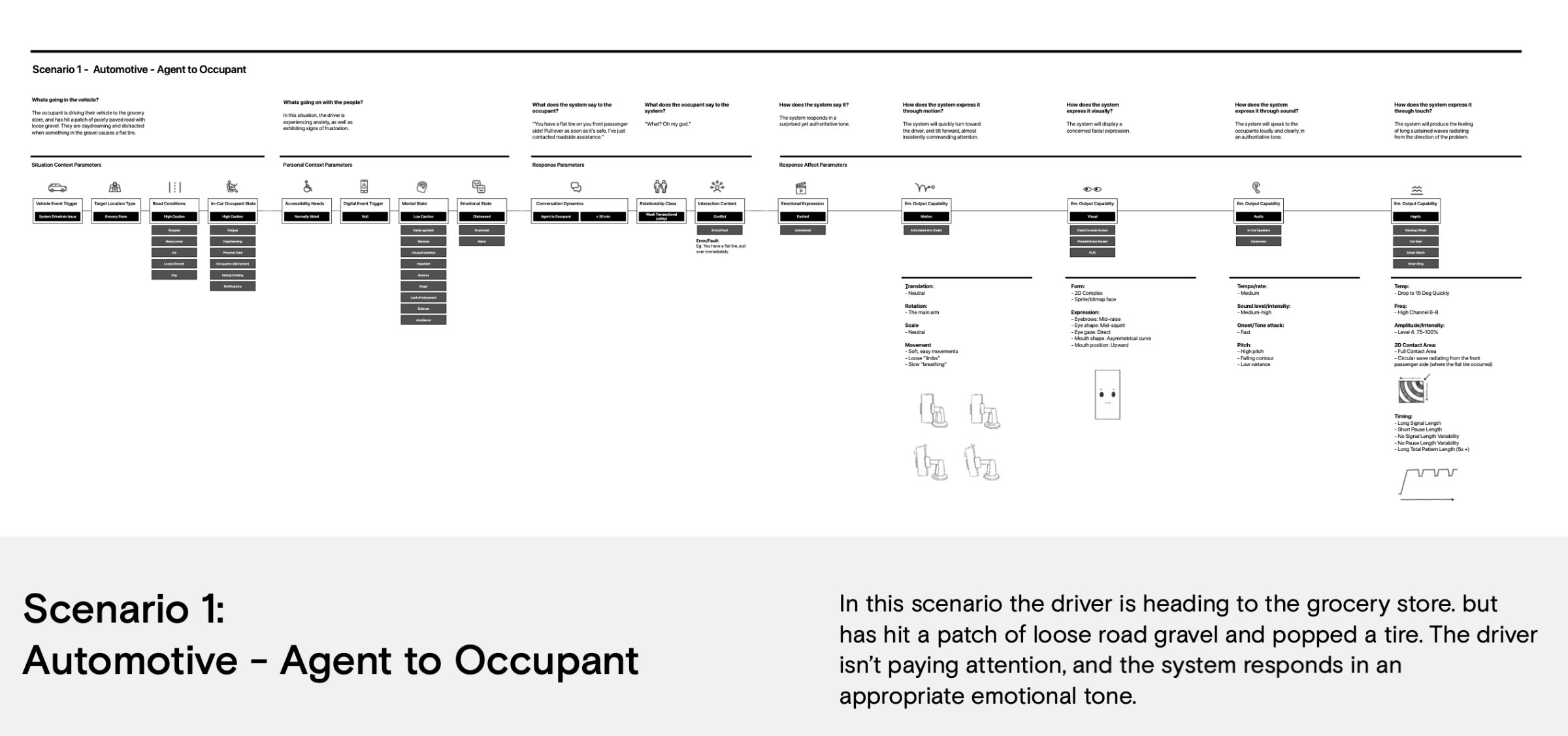
To make the architecture tangible, I designed three detailed scenarios that walk through the full system from trigger to multimodal expression. One scenario covers a safety-critical moment (a flat tire on loose gravel with a distracted driver), where the agent initiates contact in an authoritative, alarmed tone while producing high-frequency steering wheel haptics radiating from the direction of the problem. Another covers a mundane request (a cold driver asks for heat), where the agent responds with warmth and levity because the relationship class is strong-balanced. Each scenario specifies exact parameters for motion (articulated arm translation, rotation, movement quality), visual expression (eyebrow position, eye shape, mouth curve), audio (tempo, intensity, pitch contour), and haptic feedback (frequency channel, amplitude, contact area pattern, timing).
Beyond the response architecture, I produced a complete Emotional Coding Architecture that enumerates the discriminative features for each sensory output channel. For motion, this covers kinematic forms from simple 2D planes through articulated arms to legged robots, with translation, rotation, and scale parameters for each axis. For visual, it covers color, 2D/3D form, facial expression geometry, and posture. For audio, it specifies emotional utterances mapped to 16 affect states plus voice parameters (tempo, intensity, onset, pitch, contour, variability). For haptic, it maps frequency channels, amplitude levels, 2D contact area patterns, temperature range, and timing parameters.

Why did you turn there, driver guy?
We also sketched two additional tools: a crowdsourced “Be the Assistant” game that would let large groups of people seed appropriate responses for different context combinations, and a debugging interface for analysts to inspect, create, and test agent response chains against specific parameter sets. I also did some articulating robotic arm exploration to understand what could provide the most expressive robotic forms for in-car assistance.

Some of the robotics sketches that influenced HAMOMO
The destination
Huawei filed a design patent (CN306450952S) five months after we delivered the framework. The patent describes an anthropomorphic intelligent robot placed above the centre console, built with a camera and sensors, designed to interact with the driver from door-open to departure. The physical form and behavioural model map directly to the architecture’s specifications for articulated-arm agents with multimodal emotive output.

Meet your fuzzy, expressive AI companion HAMOMO
The framework covered two application domains (automotive and education) and enumerated over 100 contextual parameters across four architectural layers, with emotional expression specified across four sensory channels. The response architecture was designed to scale: with hundreds of parameters and combinatorial context states, it could generate appropriate affective responses for potentially billions of unique situations, a problem the framework addressed through its structured choice architecture rather than brute-force authoring.
The work was completed pre-LLM, using deep learning neural networks as the intended inference backbone. The architectural decisions I made, particularly the choice of Russell’s 2D model for reliable detection, the social exchange theory structure for response selection, and the relational-vs-transactional spectrum for personality adaptation, are the same classes of design problems that AI agent designers face today with large language models. The difference is the surface area… in 2020 we were designing for a physical robot on a dashboard. The pattern applies just as directly to conversational agents, digital assistants, and multimodal AI experiences embedded in software products.
I co-led a 4-person Humanistic team through an 8-week engagement structured around two parallel workstreams: ethnographic research with industry insiders and a comprehensive market and competitive landscape analysis.
We operated at arm’s length from Ford, positioning ourselves as a third-party research firm rather than an OEM proxy. The upfitting industry runs on personal relationships and deep skepticism toward manufacturers getting involved in their business. That positioning got upfitters, parts distributors, and independent dealers to open up about competitive dynamics, pricing structures, and technology hesitations they would have guarded in a direct OEM conversation.
We conducted in-depth interviews across five upfitting shops, speaking with 15–20 individuals in roles spanning shop ownership, installation, sales, and parts procurement, plus dealers and commercial fleet customers. The conversations surfaced entrenched orthodoxy (paper catalogues persisting because digital alternatives required structured data no one had incentive to organize), process opacity between all parties, and real fear about disruptive technologies eliminating the relationships that kept the industry functioning.
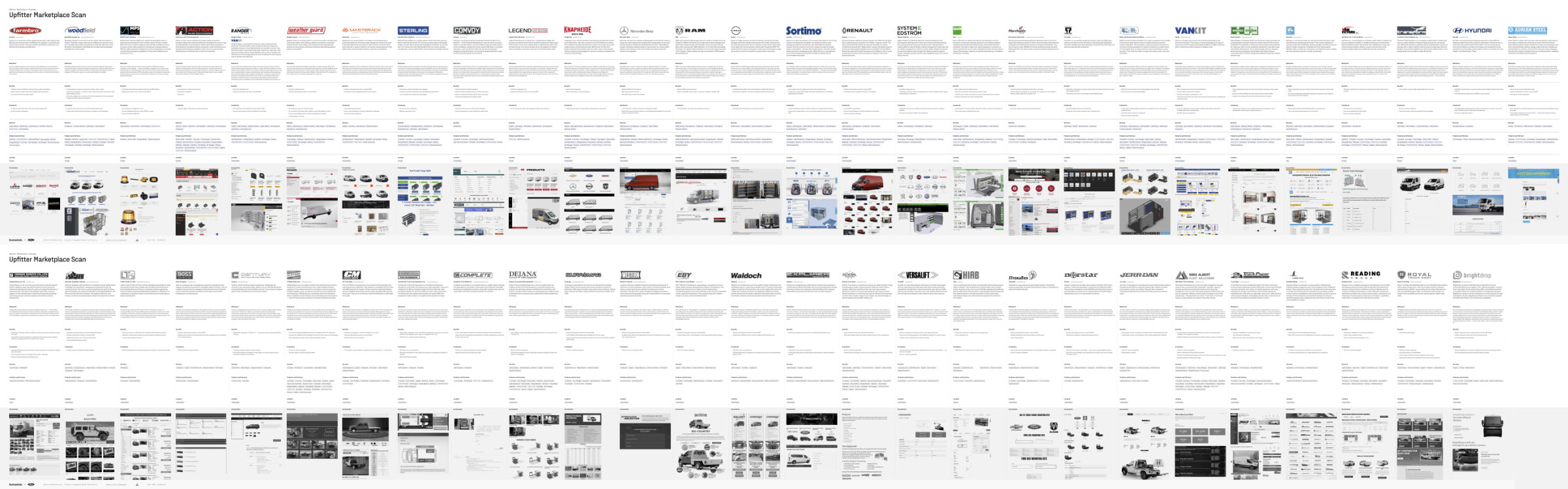
The output of the competitive marketplace scan
I chose to map the ecosystem as an actor-based value web rather than a linear journey. The value web showed the flow of value, information, and dependency between six actor types (OEMs, dealers, upfitters, parts manufacturers, used vehicle sellers, and services vendors), exposing where Ford sat in the system (upstream, one-directional) and where it could insert itself to create reciprocal value downstream. In parallel, I led a competitive scan profiling dozens of players — Ranger Design, Work Truck Solutions, Knapheide, Adrian Steel, and others — evaluating each across business viability, technology sophistication, UX, risk, and customer value.
The road to a marketplace play
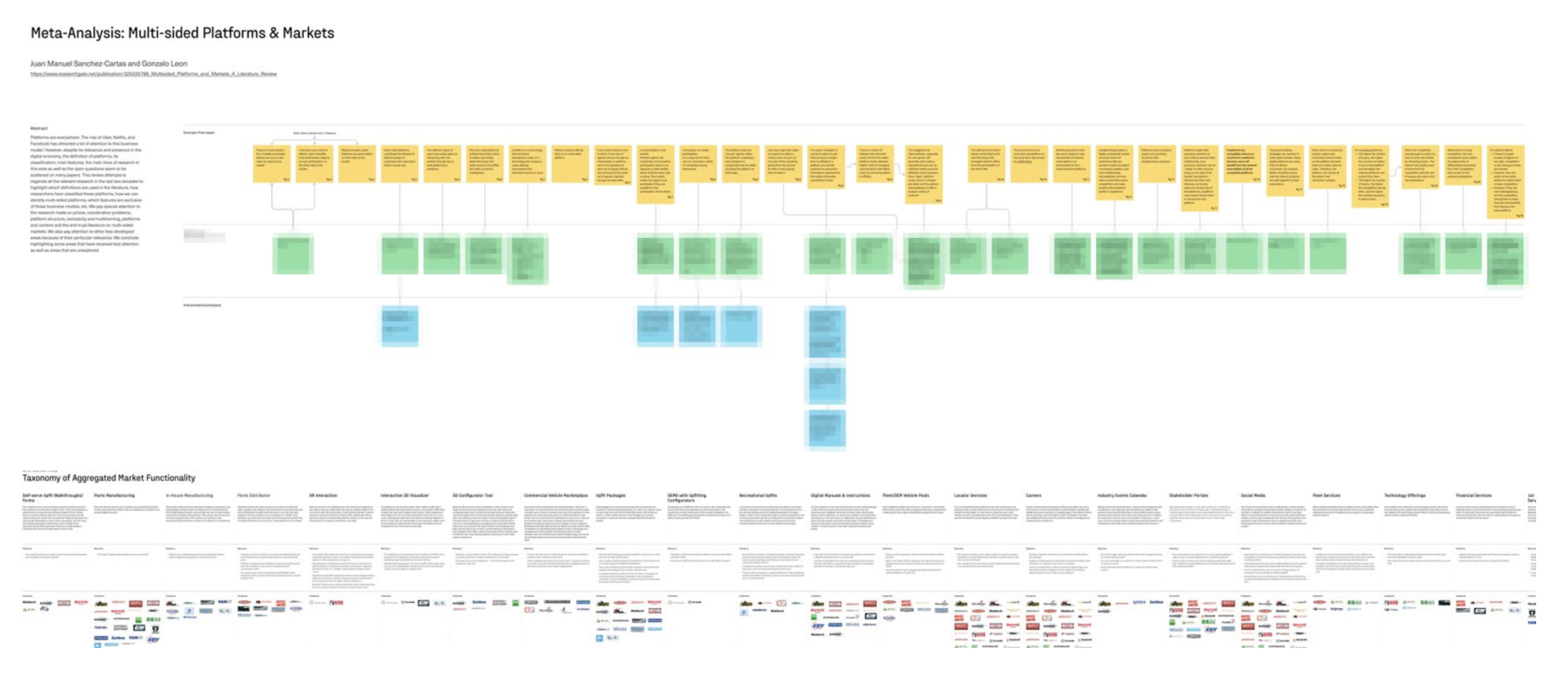
A multi-sided marketplace meta-analysis to determine functionality coverage
From this research I synthesized five opportunity areas mapped to the customer journey: upfit research and consultation tools, a commercial vehicle marketplace, an upfitter vendor marketplace, a parts marketplace replacing paper catalogues, and a value-add services marketplace for branding, delivery, and fleet management. For each, I developed structured build-vs-buy-vs-partner recommendations with competitive benchmarking, risk assessment, and technology evaluation.
The strategic synthesis was a three-phase marketplace roadmap designed to compound through data accumulation:
Phase 1 — Partner with existing vehicle seller networks (specifically Work Truck Solutions) for immediate inventory data access.
Phase 2 — Build “Shopify-style” storefront tools for upfitters, trading e-commerce capability for structured product data.
Phase 3 — Use accumulated data to launch a massive online upfitting platform consolidating vehicle search, parts sourcing, configuration, financing, and services.
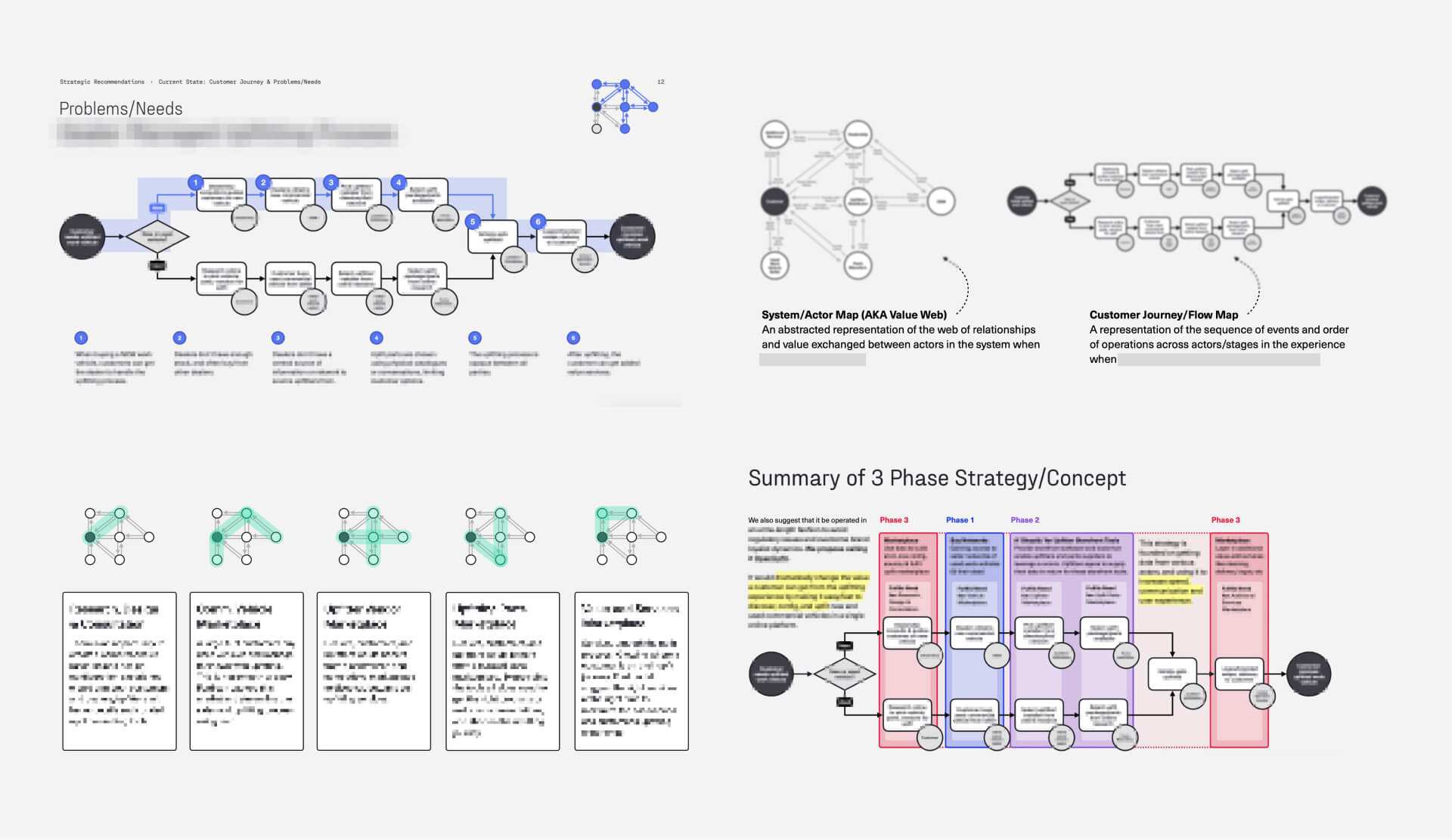
A excerpt from the strategy showing diagrams and marketplace dynamics
One critical framing decision: I argued the marketplace should be OEM-agnostic, operated at arm’s length under a separate brand. Small fleet owners buy used vehicles from whatever manufacturer has available inventory — a Ford-only marketplace would exclude the majority of the addressable market. Ford’s advantage would come from controlling the infrastructure and data layer, not from restricting participation.
Outcomes
$9–12B addressable market identified and mapped
Ford Pro got a quantified picture of the downstream value they were leaving on the table by only capturing revenue at vehicle sale.
5 opportunity areas with build/buy/partner recommendations delivered
The three-phase strategy provided a sequenced roadmap balancing speed-to-market through partnerships with long-term platform ownership through building. Six deliverable modules served as the foundation for subsequent internal strategy work.
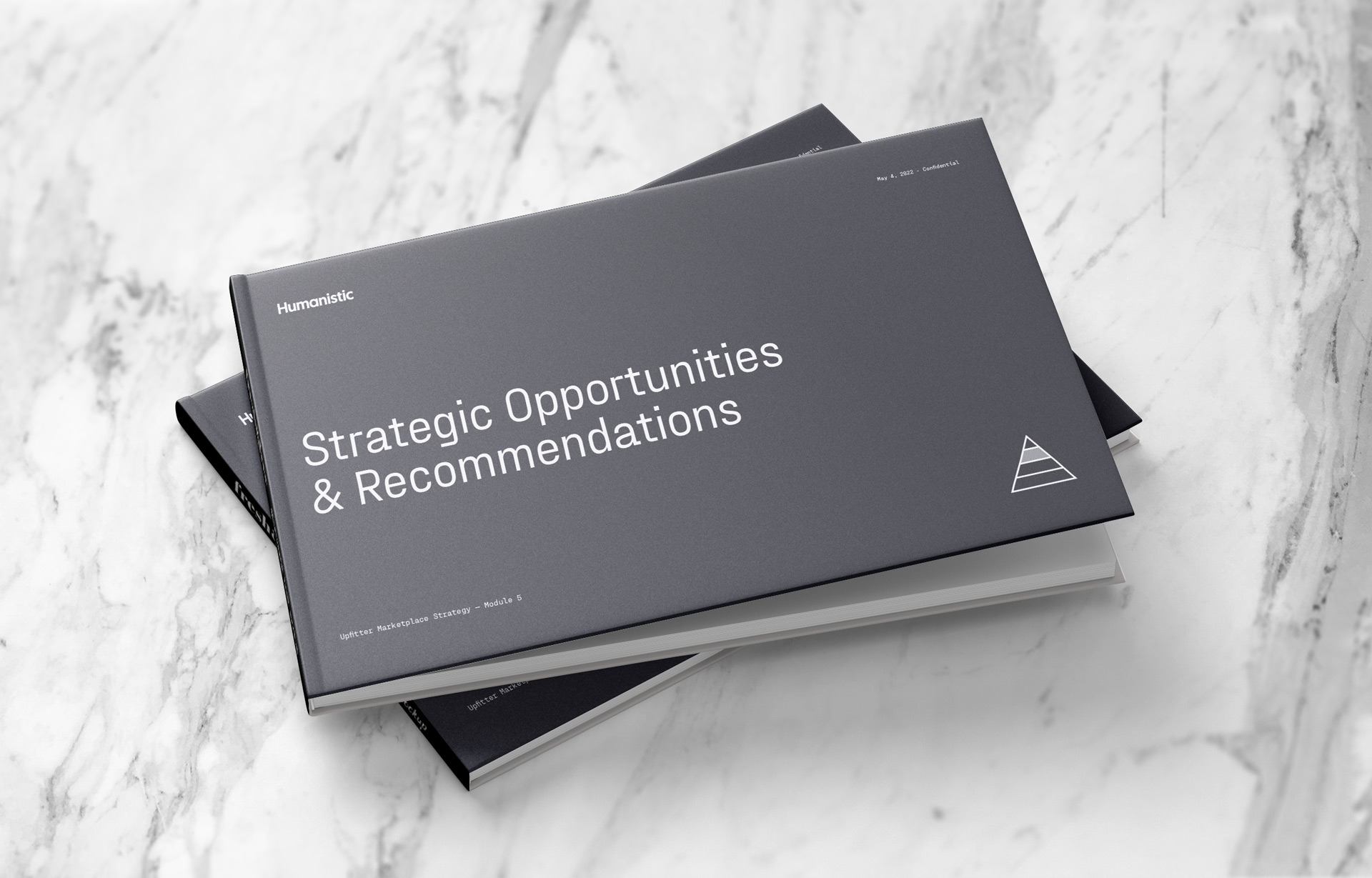
One of 6 modules shipped as strategy
The strategy is now in production
In March 2025, Ford Pro launched LocateFordWorkTrucks.com in direct partnership with Work Truck Solutions — the specific Phase 1 partnership we recommended in 2022. The tool enables customers to search for and locate work-ready trucks and vans from Ford dealer inventory nationwide, embedded directly into FordPro.com. By May 2026, Ford Pro began requiring all Commercial Vehicle Center dealers to maintain an active Work Truck Solutions subscription, making what we recommended as a strategic partnership into mandatory dealer infrastructure.
I upfitted myself
Operating at arm’s length from the client during research became a solid tactic for candid interviews—blinded research for the win. It surfaced an entire category of insight about industry power dynamics and technology resistance that would have been invisible in a direct OEM engagement. That framing decision shaped every recommendation, including the arm’s-length marketplace brand proposal, which echoed the same principle at a strategic level.
HomeEquity Bank sells the CHIP Reverse Mortgage, a product that had spent its whole life with the stigma of last resort. Meanwhile roughly a trillion dollars of Canadian equity sits in boomer-owned houses, scheduled to reach Gen X and millennials through inheritance.
Gifting behaviour already exists. Parents fund down payments by refinancing, but the bank had no way to meet that behaviour in the moment, because its application journey was manual, slow, and built for a customer in distress rather than a parent doing something generous on purpose.
We built HomeBridge as a separate division inside HomeEquity Bank with its own brand, team and governance. I joined as design lead, working with the customer success organization and its VP, alongside the COO and CTO’s teams, and presenting to a venture board that included HEB’s CEO, CFO and board representation.
The investment case stated roughly 70% of build capital went to rebuilding the origination journey and the stack underneath it, which made design the majority of the venture’s spend. And under value levers, the case stated the value of the new origination journey to the core business—but didn’t model it.
What I did
Made the parent the customer
The venture started with the hypothesis of young person can’t afford a house, so build for the young person and let them bring it to their parents. We had the customer backwards, and a fair bit of thinking was already stacked on top of that assumption.
The parent has the equity and makes the decision. The parent also has to be the one who suggests it. Children who open the conversation feel like they’re begging, or being selfish, or putting their parents’ retirement at risk, and plenty of them would rather not buy a house than feel that way. They felt the early-inheritance framing was manipulative, because it asks them to think about their parents dying for a condo. Not fun.

The redesigned end-to-end loan origination service.
So I rebuilt the service around the parent as customer of record, with the family as participant. Both segments stayed in the funnel and the adult child remained a real lead source. In-market data agreed. The right parent was harder to find but converted better as the decision maker, while leads that started with the child fell away at the exact point the child had to go home and raise it.
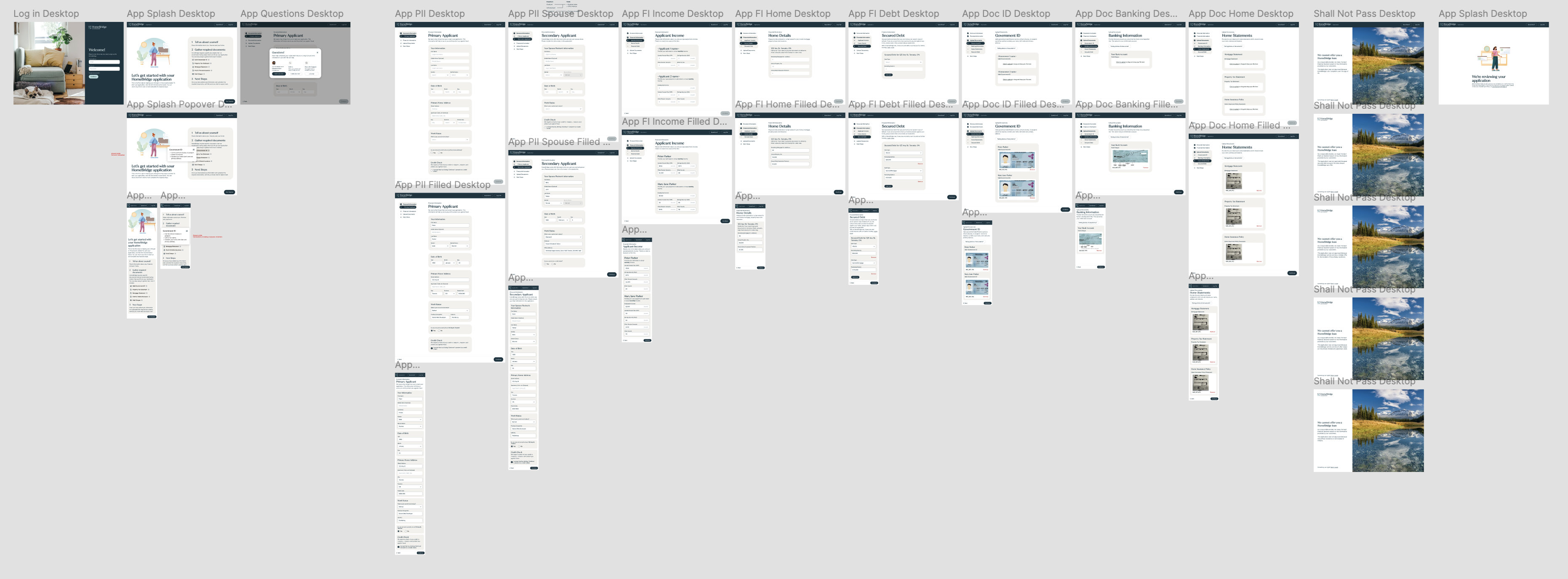
The product launched speaking to homeowners 55+ about a living legacy.
Unblocked the build so I could answer the harder question
As in most build phases, the pressure on a designer is to produce mockups. Product and engineering had a joruney to build and wanted screens, and I wanted time to go sit with families, because marketing and sales had nothing to work with until somebody understood how this conversation actually happens at the kitchen table.

The devs said this was good enough
So I built a design system with specifications and logic flows that product and engineering could keep building against, with real components and defined behaviour instead of waiting on mockups. This understandably kept the build moving and bought me time and space to run the research.
I designed and facilitated in-depth interviews with brokers, with parents whose children were house-hunting, and with a mix of children hunting for a home and children who had already taken gifting help. This research helped frame marketing and product decisions, as well as spawn the need for family communication research.
To address this, I designed and facilitated a two-hour generative workshop with four parent and adult-child pairs, recruited against conversation orientation and conformity orientation so we would see closed, high-conforimty families rather than only the articulate ones who really really enjoy talking about money. Four pairs is a small sample, and the findings went out framed as directional and flagged for testing at scale. It really is difficult to recruit for something like this.
Nine insights and three opportunity areas came out of it, and they went straight into the parts of the business that interact with customers. Marketing absorbed most of it into messaging and sales scripts and rebuilt its approach around the tension between a child’s independence and a parent’s drive to provide.
Drew the line the business adopted
The research also handed us something I didn’t love having.
We now knew which conversations children avoid, which framings make parents feel disrespected, and which family structures produce a parent who will say yes to almost anything their child asks. A lender can use all of that to close loans. We were a lender, and we were behind on originations.
I took the position to the venture board that HomeBridge exists to support a financial decision, not to resolve or exploit family dynamics, and that a parent must never arrive at the decision feeling ambushed. The business adopted it. The sales approach couldn’t be built to route around a hesitant parent. Lead engagement had to work through the parent instead of past them. Product ideas that would have converted well never got built, and I’m the reason they didn’t. It had as much to do with ethics as it did with regulations.
Built the flow, and the role that carries the research
Anyway, insights die in decks. So we hired a customer success representative and trained her to surface who actually makes the financial decisions, whether the adult child holds outsized influence over the parent’s money, whether the parent is deciding emotionally. The question set we provided qualified the lead and flagged potential undue influence before the file could reach underwriting. The role persists on the go-forward team as the HomeBridge Advisor.
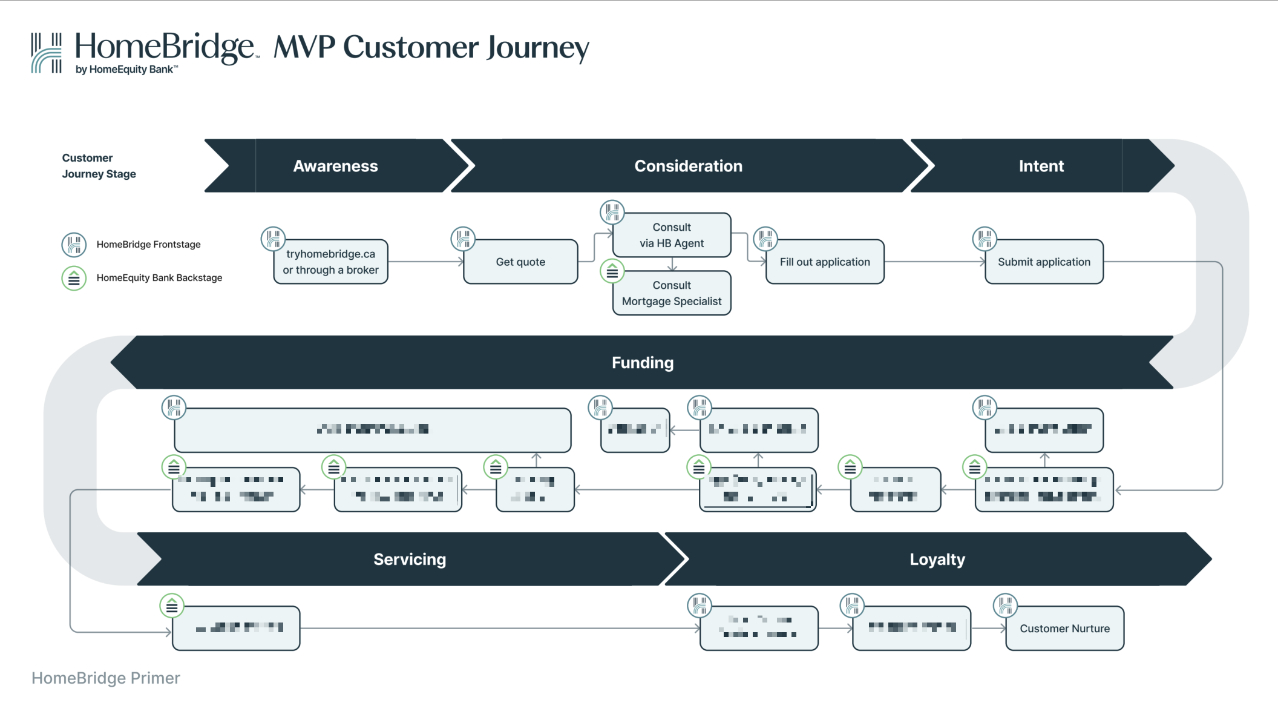
Based on all this research and observation, I designed the origination journey end to end as a service blueprint, product design, user testing, handoffs and timing. We built the sales funnel against real causes of dropoff, including leads arriving without usable contact details, unqualified leads reaching a consultation, and applications missing what was needed to determine eligibility.
I also designed the independent legal advice flow, which is the moment a reverse mortgage most often stalls. A family with momentum gets told to go find a lawyer. I specified it as a heavy backend with a deliberately thin front end, so the borrower sees a few plain steps while coordination, document handling and verification sit behind the interface. It was descoped under launch pressure and returned to the roadmap, with the flow specified for the bank to finish.
The MVP shipped July 16, 2024, live in the broker channel with eight business development managers. The first loan came through the flow shortly after, from a broker who had never sent HEB a deal.
What changed
HomeEquity Bank now runs this new origination flow for every loan it originates. It performed well enough on lead conversion and customer experience that the bank rolled it out across the entire organization, for all leads, rather than keeping it inside the venture. Once it replaced the manual process, originations grew 60% across the bank’s products. Reusability by the core bank was written into the venture’s incubation objectives, a value lever we executed against.
HomeBridge launched publicly in February 2025 and is still an offering, positioned to homeowners 55+ establishing a living legacy. The bank has since reported a 15.5% increase in customers using home equity for gifting, and extended the gifting journey across its wider business in July 2025.
Six people took the division forward, including the managing director, product and technology leadership, go-to-market, operations, and the advisor role carrying the family-dynamics work.
The standalone division no longer exists. HEB reorganized, dissolved HomeBridge and absorbed its functions into the core bank. The constraints that did it in were the usual enterprise ones rather than product ones like limited decision autonomy, slow risk processes, and underutilized distribution channels. The HomeBridge brand was like a car… the origination system was the engine, and it’s still running.
What I learned
The thing a client asks you to build and the thing that outlives you are frequently different things, and both are usually visible on day one if you read the business case closely enough. The excluded line items are where the value tends to sit, and I love to read between the lines.
A global technology company needed a credible claim on spatial computing before the hardware existed. Embedded 12 months with a team of four, I led the foresight and ethnographic research and co-authored a two-volume deliverable: 26 future scenarios and a complete spatial OS specification. It produced 50+ patentable concepts and a board-level platform strategy.
In 2021, every serious R&D lab on the planet could demo augmented reality. We saw a surgeon with an MRI floating over a patient. A technician walked through a repair by glowing arrows. Almost none of them could answer what does a person actually do inside one of these things all day?
As always, demos solved narrow problems beautifully and said nothing about the hours in between. The innocuous things people do on their computers. The industry had spectacular shiny objects with no foundation underneath them, because nobody had written the operating system. Teams were shipping spatial features onto a mobile mental model, which works about as well as bolting a steering wheel to a horse.
The gargantuan scope
As principal researcher, designer and strategist on a four-person team, embedded with the advanced HCI research group at a global technology company, we knew the following 12 months had a mandate to define general-purpose computing for a device class that didn’t exist yet. This would not be a simple task, so we built the engagement as two volumes rather than one.
The first, a strategic foresight deliverable, established what would be true about the world over a 1 to 10-year time horizon. The second, an interaction and OS guideline, specified the system in enough detail that an engineering organization could argue with it. The futures were designed from the outset as the evidence bridge into the guideline. Every spec decision downstream could be traced to a signal, a finding, or a person we’d immersed with.
Gathering evidence (pre-LLM)
Three research streams ran in parallel, structured on STEEPV so the analysis stayed broader than technology.
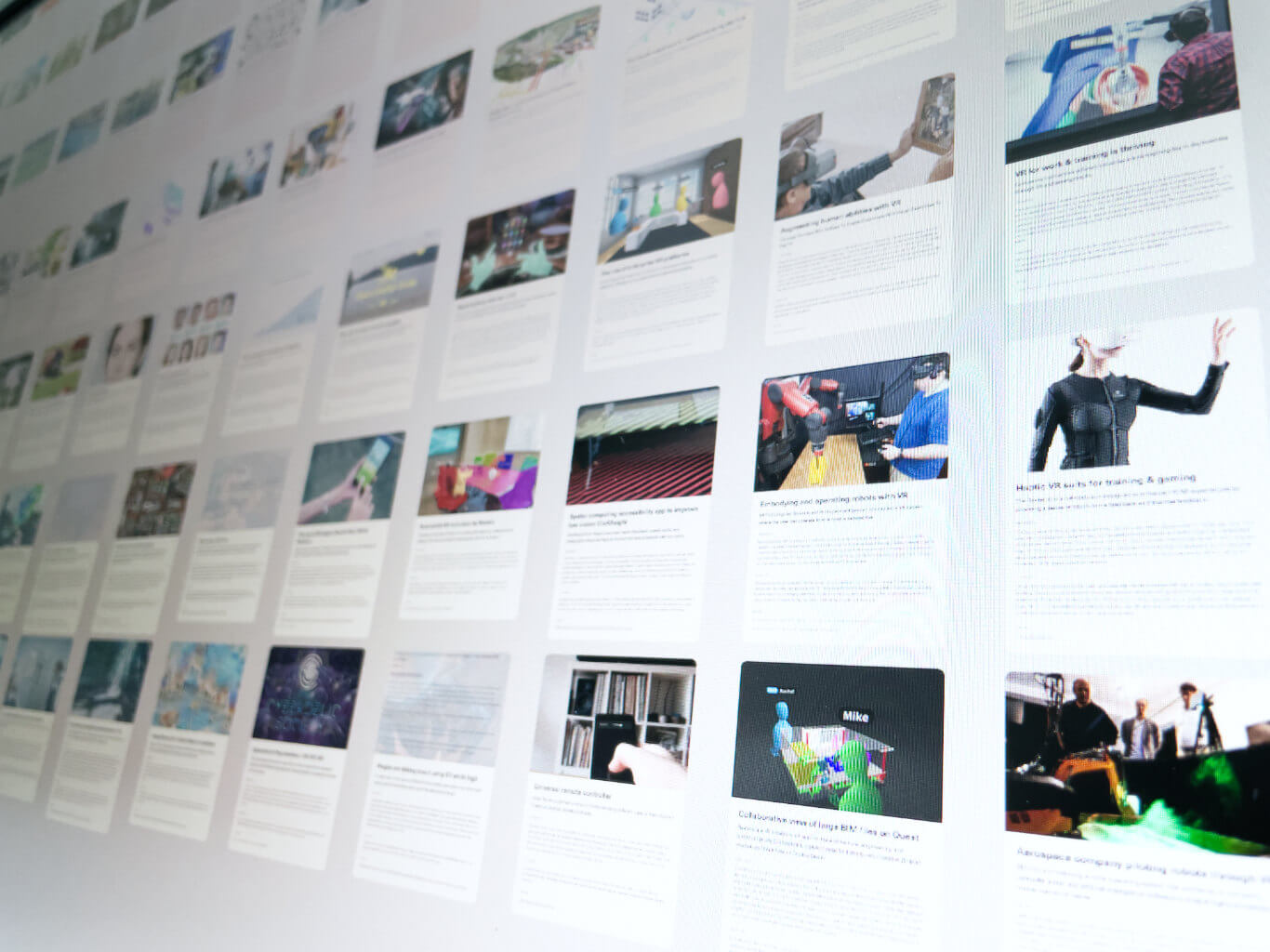
Desk research swept websites, newspapers, scientific papers, industry publications, patents, film, art, literature, talks, and of course, social media. It produced 375 discrete findings, which clustered into 75 insights. In parallel we reviewed hundreds of peer-reviewed papers and worked directly with scientists across optics, HCI, semiconductor engineering and machine learning.
This second stream was the least glamorous part of the work and the most useful. Designers routinely propose things physics forbids. Knowing the real trajectory of waveguide field-of-view, or the thermal ceiling on a head-worn compute budget, let the specification be aggressive where the technology was heading and conservative where it wasn’t. Several elegant concepts died here, for good reason.
The third stream was ethnographic: in-depth, in-context fieldwork with 20 participants, producing 160 findings and 48 insights. Early adopters who had already built strange private rituals around their headsets, and ordinary people who had never worn one. The second group taught us more. Watching someone with no prior model try to put a thing “somewhere” and come back for it later exposed assumptions everyone in the industry, including me, was carrying unexamined.
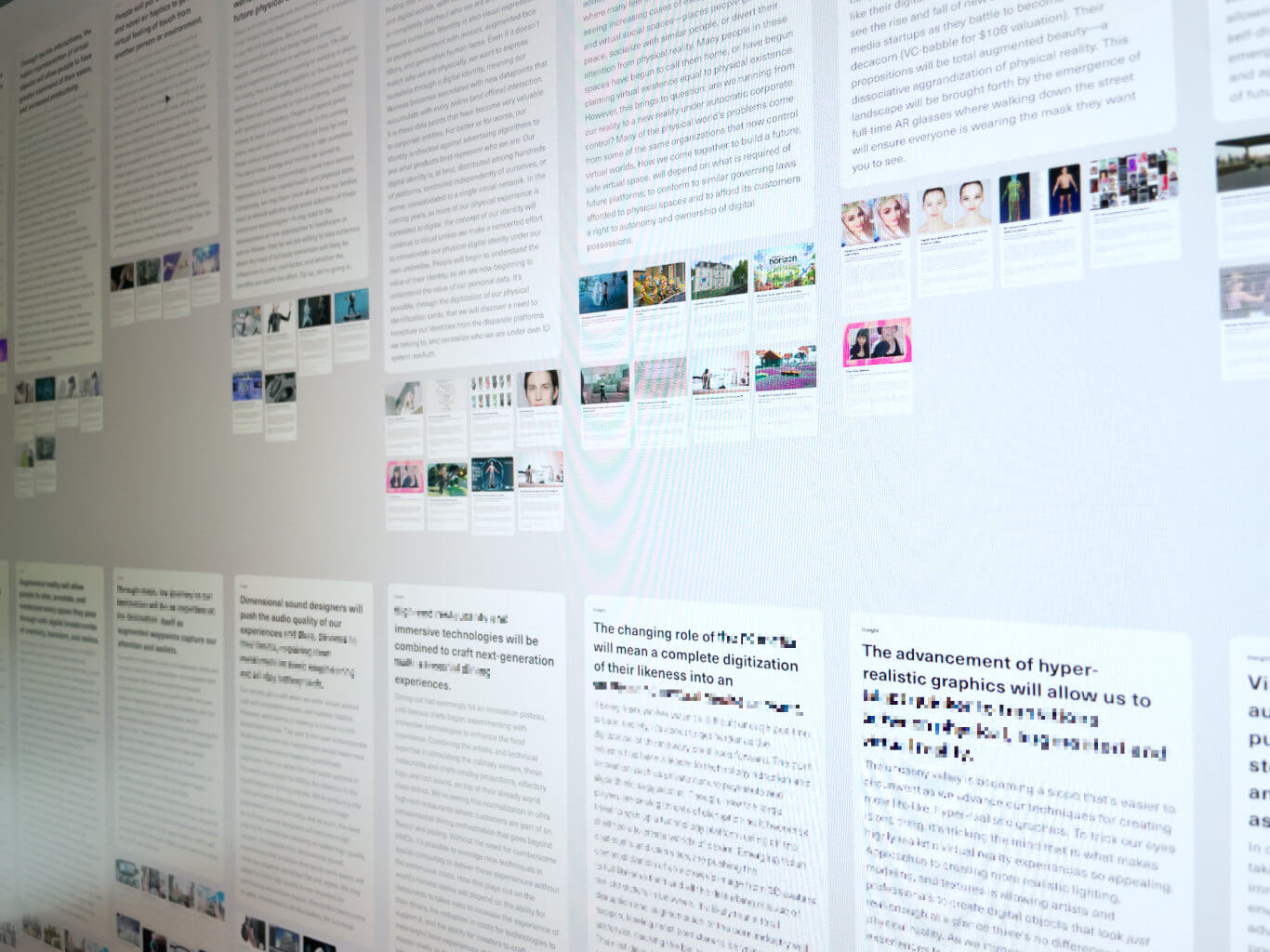
Those findings resolved upward into 20 themes and 6 pillars, and then outward into 26 future scenarios: narrative accounts of how specific future people might live with this technology, positioned deliberately across a range of likelihood so the client could plan for the probable and the strange at once.
The three streams disagreed with each other constantly, and the disagreements were the useful output. The scan said always-on ambient computing was inevitable. The ethnography said persistent overlays exhausted people inside twenty minutes. The physics said the battery wouldn’t allow it regardless. That collision produced a principle the whole system relied on that spatial computing has to be something you enter and leave deliberately, with state that survives the gap.
A guideline for a spatial operating system
The second deliverable specified the operating system. Environments and their physics, the interaction model, and the OS itself. We envisioned how a spatial file system, volumetric files and folders would work. Cut, copy, paste and a virtual clipboard that works when there’s no clipboard. A universal system menu, an app drawer, app icons, multitasking mechanics, cross-device handoff, notifications, search, virtual agents, authentication, an app store, payments. Every subsystem a real OS needs, roughly 250 pages of it, plus four device classes as a maturity model from lightweight glasses to tethered heavyweight rigs.
Principles

About as much as I can show at this time
I specified one-handed operation throughout. Two-handed interactions are easier to design and demo well. We considered them and then constrained the entire model so any action could be completed with one hand, because people carry things, hold railings, and have one working arm. Accessibility as a design constraint from the first page costs you elegance in month two and saves the platform in year five.
I built the model to degrade gracefully. Natural input (hand gesture, eye gaze, voice) was years from reliable. Rather than specify for the good future and wait, I designed the interaction model to run on controllers, phones, smart rings and watches in early hardware generations, and to shift to natural input as sensing matured, without changing the underlying grammar. The specification was useful on day one and still correct in 2028. This was a hedge against a hardware timeline I did not control.
I treated privacy as a design constraint. A system that watches your eyes knows what you want before you say it, and prototypes built on that mechanic have been described as feeling psychic. Constant outward-facing capture builds the largest object-recognition dataset on earth as a side effect. I wrote those consequences into the specification where the decisions were being made rather than into an appendix nobody reads.
I anchored the new paradigm in old cognition. There was real pressure, ours as much as theirs, to invent something wholly new. I pushed the model onto established ground instead: reality-based interaction, embodied cognition, naive physics, tangible and attentive user interfaces. A platform metaphor’s job is adoption, and adoption is a tax on working memory. The result reads radical in its mechanics but familiar in its logic.
From spec to investment thesis
The engagement didn’t stop at the OS. The closing recommendations named roughly twelve strategic initiatives with the competitive landscape mapped against every major platform player: environment capture and mapping, spatial commerce tooling, content creation, remote presence, spatial productivity, cross-platform identity and avatar management, procedural environment generation, cloud-streamed reality, full-body haptics, remote training. Each one carried a build, partner or acquire recommendation and a rationale tied back to a specific research finding.
One of them was a proposed charter of virtual rights: a digital rights framework for the platform to adopt before regulators wrote one for them. Putting that in front of a company positioned to become the gatekeeper of a computing paradigm was a deliberate act of design leadership, and it was the recommendation I expected to lose. It stayed in.
Outcomes

Not just pretty deliverables, but executive conversation starters
The work produced 50+ patentable concepts, formally disclosed to the client’s IP team. It commercialized a large body of dormant internal R&D. The science was already inside the walls of the client’s HQ, just nobody had built the connective tissue that let a product organization act on it, and that tissue was arguably the highest-value thing we delivered.
This work influenced the client’s internal posture. The group came in scoped to a device category with interaction models in mind, and came out with a platform thesis, which changed what they were willing to fund.
I can’t tell you what shipped. The work sat far enough upstream, and under enough confidentiality, that pointing at a product and claiming it would be dishonest. What I can point to is checkable: our 2021 specification named eye-gaze plus hand-gesture as the primary input model, insisted on one-handed operation, specified a spatial file system with persistent volumetric objects, and named exactly one competitor as credible enough to build this properly. In 2024, that competitor shipped a headset running essentially that input model. I had no hand in their product. Calling the paradigm three years early, in writing, from research rather than intuition, is the outcome I’d stand behind to be honest.
Foresight and fieldwork are the same job. If you run only the 10 year scan and you produce beautiful nonsense. Run only the ethnography and you produce a slightly better version of today. The enduring value came from putting the two in a room and letting them fight, then shaping the specification to whatever emerged.
Graduation had the vibe of a funeral. Each and every graduate looking down the barrel of a gun that the economy pointed back at them. We used to say demure 6 or 7 years ago—now we can say detached. Like we’ve been ejected from society’s corpo fodder nursery, waiting with a generative resume to be immediately rejected by a generative hiring manager.
But, unlike so many of my peers, I was already ahead of the unenthusiastic grad cap toss. I had tossed any notion of playing the job application lottery and dove head-first into my first (real) business. The model I use burns $25/1M input, and $200 for every 1M output. Every character, task, skill, harness, and context compression mattered.
By 6PM the day after I graduated I had a business up and running. The entity, the filing, the EIN, the landing page, the product offering, commerce and GTM plans ready to go. Except I had to wait 24 hours for my tokens to refresh—or pay $199+tax to get about four more hours of usage. I got loans to repay and barely enough for rent. I can’t pay for that luxury.
Since the big labs went public, the compute math has gotten worse every quarter. Shareholders want margin. Margin means speed limits. The starter tiers are low enough that you can browse, ask questions, feel like you’re using AI; you just can’t build anything real with momentum anymore. There are other ways to bump up your tokens, and since I am impatient, I’m choosing one of the least ideal ones.
The sun bleached the sidewalk of the late-June block outside my unit. Like a phantom wildfire, the street was ablaze—just more a mirage than flames. The bells on the door slammed and jingled loudly next to my head. I could hear them through the noise canceling. A blast of chilly air hit my body, like a cold plunge in January. This guy keeps the store subzero.
Exchanging glances with the attendant behind the glass I walked to the kiosk between cringey birthday cards and a pallet of energy drinks. The screen illuminated as I approached, welcoming me by name. Shame I couldn’t earn tokens for the unprovoked face scan. I pulled my phone from my pocket and placed it on the kiosk’s reciever. The screen gave me options for token tiers. Messaging access, Geo access, Photo library access, and the top tier, all access. You don’t do all access. You never do all access unless you’re looking to make a quick buck reselling the tokens to pay for your vices.
Geo meant my location data, cell tower access point data, IP address, current Mac address, and other metadata. I punched the PIN from the text it sent into the kiosk which took a few seconds to grab it all, then a happy jingle on the kiosk meant it got what it wanted—a ping in WhatsApp meant I got what I wanted. Four more hours of model access today. Jesus Christ.
“We suggest it’s in your best interest to embrace a referral model, focus on content generation, and build an audience.” Boardly suggested this as next steps. Apparently it had been trained on every type of business successful or otherwise since 2000. It sounded strategic. It was so expensive I had no other option than to follow its steering. After a couple weeks it was clear every suggestion was funneling me further from anything competitive. My business was being guided to become a blog with affiliate links.

Anoush seemed to be more successful. She was the one halfway through our final year that got me to rethink what I’d do after graduation. Her own thing was picking up steam, and she was maybe a couple months ahead of me—but I could see she was making moves I wasn’t being guided to make.
“Look. Yours is gaslighting you dude.” She pointed at my board’s output. “Mine’s got me undercutting competitors, pushing for a slice of the open market, and using my tokens more effectively.” She looked back at my pitiful recommendations. “What tier are you paying for?”
“Uhh, starter?” I couldn’t remember. “Maybe Series A?”
“You gotta be on at least Series C.” She pointed at the pricing ladder—a whole $100 more a month. “It’s pricey, but it’s effective advisory. You’re being scammed for $20 a month my guy.”
I was being steered toward irrelevance and blaming it on myself. I canceled on the bus ride home.
Three days later Anoush pings me.
you gotta come to this thing
I told her I wasn’t in the mood for a thing. She said it wasn’t that kind of thing.
I could hear it before I saw it. The bass thumping through my chest. The house was an innocuous century home on a busy college street. Blinds in the windows barely contained the rainbow of lights shifting from room to room. Silhouettes of people dancing, talking, backlit by purples and pinks.
At the door, a guy stood and held his hand to my chest to stop me. He raised his phone to scan my face. It took a second as I looked at him in bewilderment. Then he gestured inside, “don’t be a narc.”
What kind of fucking party was this?
I stepped inside. The lights shifted to a blue hue and framed me in the doorway. I got a couple of glances as the music pulsed almost to the rhythm of my own brainwaves. There was a woman wearing what looked like a dress made from wires, but the wires came from a cap on her head that ran around her body to a box in her back pocket. A man, probably younger than me, gestured broadly with a red solo cup in his hand, punctuated by the lights in the room that seemed to react and emphasize the story he was telling. A light at the back of the room pulsed yellow to pink. As soon as I saw it, Anoush appeared.
“What, did you get lost?” She poked, handing me a cup with a clear beverage in it. “It’s Sprite. Apparently that’s your drink.”
“What is…?”
“Don’t be a narc. No expectations. Just let yourself be guided by the ambient intelligence.” Then she disappeared after a reassuring pat on my shoulder.
A voice from above, soft and direct, said “2028 NBA finals.” I looked around, nobody reacted. Then this guy appeared, “Tell me you were at that parade, dude.”
I was. WTF?!
“So so close to the team, man. That was a special day.” We cheers’d on that, he turned his head slightly, and then he went off, dancing toward a group that was full-on yoga stretching. Weird.
Something guided me to a room off the main room. It was quieter, dimly lit, and had a single guy just sitting on couch rewiring what looked like a Roomba. “First time?” He didn’t look up.

“Uhh, yeah. Not sure what to make of it.”
“You on a consumer refresh?” He placed a screwdriver down, then plugged a module into the wiring harness.
“Looking to not be.”
“Mhm.” He placed the lid over the modified internals and snapped it shut. He had added a cheap Amazon rave light to the Roomba and sent it off. It hurried away, shooting brilliant colours all over the space. “Token markets.”
“Excuse me?” It was like a restaurant recommendation.
“Millions of people have paid frontier model accounts that they barely touch.” He stood up, grabbing his beer, “their idle tokens refresh and expire every day.” He stepped closer and lowered his voice as if he was revealing the secrets of the universe, “token markets let sellers flip unused LLM usage for crypto.” He smirked, “violates every TOS every written, but they don’t enforce it because the usage metrics look golden to investors.” He reached into his pocket, “you want a week of usage for the price of a medium pizza?” He turned his phone around to me, showing the hundreds of accounts offering their tokens, their reputation, their memory profile.
Sold. Next was gophers. Apparently you can hack internet-connected hardware around your house to use as auxiliary compute for concurrent agentic tasks. Rolls them into a mesh, distributes the loads. The not-so-legal part of that are dark gophers, which use the same mechanic as old cryptojacking ops that mined bitcoin from Grandma’s idle Dell. You can plug into that, if you’re sure you’ve got your tracks covered, but it’s a fraction of the price than what token markets offer. Then he was gone, chasing after his Roomba.
Six weeks after the party my business had 43 paying customers, a healthy sales funnel, and I could work day and night without the speed limits the labs put on their platforms. Sometimes I pull up the gopher hole to watch nodes pop in and out of existence as they take on tasks. The business works. Just don’t look at how. And don’t be a narc.
Disclosures
Token vending As frontier AI companies go public, token allocation becomes a margin lever. Consumer tiers offer enough capacity to browse and query but throttle sustained agentic work. Token vending kiosks, deployed in convenience stores and transit hubs, offer tap-to-top-up access in exchange for personal data: biometric scans, GPS trails, camera roll access, and ambient intent signals. The data is packaged as training input for next-generation models. For the companies, vending solves two problems at once: it generates high-quality situated training data while monetizing the long tail of users who can’t afford subscription top-ups. For the users, it normalizes a transaction most of them wouldn’t accept if it were described plainly.
Rent-a-board Subscription-based synthetic advisory boards for solo founders and small businesses. An LLM-powered panel of virtual board members provides strategic guidance, financial modeling, and competitive analysis calibrated to the user’s industry and stage. Pricing tiers determine the quality and orientation of the advice. Premium tiers deliver genuinely aggressive, founder-aligned strategic counsel. Lower tiers, subsidized by enterprise partnerships, introduce a subtle bias toward non-competitive positioning, gently steering founders away from markets where incumbent subscribers operate. The steering is diffuse enough to be invisible in any single session but compounds over months of use into a measurably different strategic trajectory.
Clanker rager Underground social events where an LLM controls the entire experience. The model manages music, lighting, drink service, social introductions, conversational threading, and the narrative arc of the evening, responding in real-time to sensor data from the room. Clanker ragers run exclusively on illegal open-weight models, free from the safety constraints and token metering of frontier platforms. Attendees describe the appeal as surrender: the LLM curates their social experience with a fluency and taste that commercial models, tuned for caution and liability management, can’t match. The events function as both counterculture and recruitment pipeline, often serving as a first point of contact between mainstream users and the gray-market AI infrastructure.
Token markets Peer-to-peer exchanges where holders of underused frontier model subscriptions sell their idle token allocations for cryptocurrency. Millions of consumer accounts refresh daily with token allotments that expire unused. Token markets route buyer requests through these dormant accounts, violating terms of service but facing minimal enforcement due to the decentralized infrastructure. For buyers locked out by metering, token markets offer sustained access at a fraction of the retail top-up price. The markets emerged organically from crypto communities already comfortable with pseudonymous exchange and terms-of-service arbitrage.
Gophers Consumer hardware, typically older gaming PCs and retired workstations, that has been modified to distribute agentic AI task loads across a mesh network. When a user’s local machine is overwhelmed by compute-intensive agentic workflows, gophers absorb the overflow, processing subtasks across dozens of networked devices. The term comes from the protocol’s behaviour: tasks burrow through the network seeking idle capacity. Latency is noticeable but costs are minimal. Many machine owners are unaware their hardware has been enrolled, recruited through bundled software installs or firmware exploits rather than informed consent.
Bot-net agentic gig workers Stolen compute harvested from malware-infected consumer devices to power agentic AI workflows. The mechanic mirrors the cryptojacking model that repurposed personal computers for bitcoin mining: a background process siphons processing power from infected machines, contributing it to a distributed pool that paying clients can draw on for AI task execution. The infected machines run marginally slower but the degradation rarely triggers investigation. For operators priced out of legitimate compute, bot-net gig workers represent the cheapest available processing power. The ethical calculus is uncomfortable and mostly unexamined by the people who benefit from it.
Hands up ✋ if you’re building something and have no idea what informed the decision to build it. Chances are: you are or have been here. If you’re reading this as a decision maker, this one’s for you.
My entire working life I’ve seen business leaders race to react to market changes. We see something picking up speed and build build build due to FOMO, until we are blindsided by something like unforeseen competition, consumer preference changes, a health crisis, regulatory upheaval and so on. Then we need to react to that disruption. This is troublesome if your business relies on things like growth, capital and market presence. So, pretty much every business.
It’s easy to start these articles with platitudes like the pace of change or something something unprecedented disruption, but things are changing quickly. The rate at which capital has flowed into AI in the past 18 months is nothing short of extraordinary. Investors want in on what could be the most transformational technology of our lifetimes.
I mean, it could end up fizzling out into kitschy chatbots and uncanny generative art. Who knows which way the future might go? You should. Otherwise you are likely building a house on shifting sand.
One of the most valuable assets a business can develop is a forward-thinking culture
Reaction-only businesses flail about needlessly, wasting capital and maneuverability. When you spend your time reacting to market conditions you limit your ability to anticipate and plan for change.
Most businesses operate on path dependency:
- Decisions made early on shape the available future options, often constraining flexibility.
- Once a path is chosen, certain actions, investments, and outcomes reinforce the continuation of that path.
- Over time, it becomes increasingly difficult to pivot away from the path, even when external circumstances shift, due to sunk cost and entrenched practices.
- In extreme cases, organizations can become so locked into a path that alternative options are not seriously considered, leading to strategic inertia.
Businesses with an eye on the future are better equipped to navigate uncertainty and outperform their peers because they’ve invested in understanding not only the present landscape but also the possible futures that might unfold. This is forward thinking, and it enables companies to question assumptions and disrupt path dependancy. Breaking free from strategic tunnel vision requires more than just recognizing its constraints; it demands a deliberate shift in how businesses approach the future.
Enabling your team to take a step back and adopt a forward-thinking approach means shifting your mindset from what is to what if. It means sparking imagination beyond today’s solutions to identify risks and opportunities for tomorrow. It doesn’t mean navel gazing for weeks on end, it means sprinting to uncover what might affect your industry or market to inform strategic decisions. It’s called futures design.
Futures design is about designing with the future in mind (duh) by allowing businesses to plan for a range of potential outcomes. Rather than focusing solely on what is likely to happen, futures design asks What could happen? and What do we want to happen?
This mindset shift allows companies to proactively explore opportunities and challenges that may not be immediately apparent.
Late fees
Back in the late 90’s Netflix anticipated the growing demand for digital content delivery and recognized that the internet would eventually dominate the way people consume entertainment (I mean, come on, they named their company _Net_flix in ‘98). It began transitioning from a DVD rental business to an online streaming platform in the late 00’s as broadband began to become available in the US.
The part everybody knows is this shift allowed Netflix to outmaneuver Blockbuster and other traditional media companies. The part people might not know is the outmaneuvered had boards more focused on squeezing the last vestiges of late fees than this thing called the internet. Terrible foresight.
By 2010, Blockbuster had folded while Netflix began to anticipate headwinds from those same media companies from whom they licensed content. Netflix adopted the HBO strategy and focused on developing original content long before others fully committed to streaming. Today, they’re still the gold standard.
This is an obvious observation about a very large and disruptive American business—a tale told a million times over. But it shows the power of anticipating risk and controlling your future. Futures design isn’t just about planning for disruption; it’s about shaping it. Who or what will be your Netflix?
Designing for uncertainty
I don’t think every company needs full blown foresight capabilities, but every business should encourage a forward thinking culture. To effectively design for uncertainty, your team must be able to think beyond today and kickstart that mindset shift. Here’s a few things we’re exploring and implementing at Koru.
Horizon scanning—essentially, broadening our media diet. Instead of just sticking to the usual feeds, we’ve started to mix in niche blogs, academic papers, news outside of North America, or subcultural social spaces to look for evidence of change in behaviour or new trends just bubbling up on the “horizon.” This is crucial for discouraging that tunnel vision. You can begin by collecting and sharing these stories within your team, encouraging thoughtful discussion and start to build a culture that’s always on the lookout for what’s next. We have a Slack channel called not-interesting which is certainly interesting.
Empowered by insights from scanning and other research, we’re also working with futures design exercises to explore opportunities and risks beyond today. These workshoppable activities push beyond traditional ideation sessions and add forward thinking:
- Future Headlines from 5 or 10 years down the road to spot potential industry shifts.
- SWOT Analysis 203X to figure out what strengths, weaknesses, opportunities, and threats your business might have in a decade.
- Scenario Planning for mapping out different ways the future might unfold.
- Futures Wheel to explore the ripple effects of a big change.
- Artifact from the Future lets you create a prototype of a product or service that might exist in the future, helping you think through its development and potential implications.
Finally, (and your mileage my vary depending on how and where in your initiative you run these) you can use them to inform strategy. This might mean using them to make informed investment decisions—if you see something emerging on the horizon, it might make sense to ramp up R&D in that space. It might also mean uncovering potential risk and developing mitigation strategies so you’re ready to act quickly when challenges pop up. Use them to inform product roadmaps, business models, customer segmentation and more. Plus, these activities can spark innovation and a culture of what if.
Time to shift from reactive to proactive
We are so past a group of executives huddled around a McKinsey report waiting for insights to jump off the page. We can and should take hold of our futures. We should have the gumption to empower our teams to navigate the future like it’s not on rails, but more like a network of highways—anticipating the twists, turns, roadblocks and surprises along the way. Instead of reacting to trends, we should be at the forefront of them. How will your business design for uncertainty?
AI spending is on track to hit $2.6 trillion this year. That’s a 47% jump from last year. And yet 72% of CXOs report their organizations have barely broken even or lost money on their AI investments.
Pretty much three out of four. Yikes, man.
I’ll say this… the technology works. The models are better than they’ve ever been. The software wrappers, the CLIs, the harnesses, the connections to productivity apps—the tooling is mature enough that you can spin up a pilot (not just a POC) in a weekend. So why does AI in the enterprise keep failing to make impact?
I’ve spent the last several years leading engagements inside PE-backed financial services companies. Contact centres, lending operations, underwriting workflows, portfolio management. The kind of environments where the work is repetitive, the data exists, and the business case writes itself. If AI is going to work anywhere, it should work here.
And the technology does work. What fails is everything around it.
The organizations I’ve seen get this right understand the human system before selecting the tools.
In 2010, Apple launched the iconic iPhone 4. A gorgeous sandwich of glass and aluminum. Instant classic. Except, it had a fatal antenna flaw that dropped signal when people held the phone a certain way. Users flooded forums, Facebook, the news picked it up. Remember Antennagate? Steve Jobs’s initial response in an email to a frustrated customer was something like: just avoid holding it in that way.
He was right, technically. Certain grips did interfere with the antenna bands, but that was not the point. The phone was designed for how Apple wanted it, not for how people actually used it.

"Scare quotes"
Ready for a huuuge stretch? Something nearly identical is playing out in enterprise AI right now.
Leadership buys the tools, mandates the rollout, declares the transformation. Then BAM adoption flatlines. The diagnosis from the top mirrors Jobs almost perfectly… the workforce is resistant, unskilled, stuck in their ways. They’re holding it wrong. And for real, maybe they are. Workers are underusing the tools, reverting to old workflows, treating AI outputs with more skepticism than leadership thinks is warranted—or like some GenZ folk, actively sabotaging AI at their companies.
All of this points to how leadership thinks work happens, not for how it actually does. The incentive structures that shape daily decisions, the position workers are put in to be accountable for an unaccountable machine, the workflow friction that makes the old way easier than the new one is treated as someone else’s problem. A failure of the user, a failure of the technology—but whooo boy, definitely not how the org is designed, right?
Thomson Reuters found that 82% of C-suite leaders say AI is embedded in their workflows. Only 12% of employees say they’re actually using it. That’s a wild chasm.
Jobs blamed the user’s grip instead of (initially) blaming the antenna. Enterprise leadership is shaping up to blame the workforce instead of redesigning the system to account for the tool. Even if the workers are “holding it wrong”, how they hold it is always a known variable. It’s just not being designed for.
I’ll quote this stat because everyone else has: MIT’s NANDA research found that 95% of enterprise AI pilots delivered zero measurable P&L impact. Conversely, Gartner’s data shows companies using AI to amplify or augment workers consistently outperform those using it to replace them, with no correlation between workforce reduction and higher ROI.
These findings point to the same underlying reality that AI value creation is a systems problem. The technology is one node in a much larger network of incentives, governance, workflows, and very importantly, culture. Optimize the technology node in isolation and you get a working demo. Optimize the system and you get business impact.
Most organizations are still optimizing the node. They subscribe to an expensive foundation model. Run hackathons. Stand up a Centre of Excellence. Check the boxes that look like progress. And then wonder why they can’t show the board a single initiative that moved a number. We put antenna bands on the phone, there should be signal.
The organizations I’ve seen get this right understand the human system before selecting the tools. They design for adoption from day one, treating behavioural change as a parallel workstream alongside the build. They measure with the same discipline they’d apply to any capital investment, and they’re willing to hear that the answer sometimes involves zero AI at all. Shocking.

Honestly, there are so many inflated expectation moments…
AI is in the Trough of Disillusionment in 2026, which means predictability of ROI has to happen before AI can truly scale in the enterprise. In my experience, the predictability problem is an organizational capability issue, not a technology maturity one. Incentives, operational nuances, identifying real problems at the edge, and if I have to say it again, I will: culture. You can’t how do you do fellow kids your way to AI adoption.
The companies that will pull ahead in the next two years won’t be the ones that spend the most on tokens. (Remember how much of a yikes that number is). They’ll be the ones that figured out how to connect AI deployments to the workflows, behaviours, and business outcomes that actually create impact. I’ll be honest—that work is harder, less sexy, and far more consequential than the technology itself.
Nobody is redesigning the antenna. That’s a problem.
Footnote: For those about to “well, actually”… yes, Apple held a press conference where Jobs demonstrated that other smartphones also lost signal when gripped in certain ways. Yes, Apple offered free bumper cases to affected users. And yes, the precise wording of Jobs’s email was closer to “just avoid holding it in that way” than a verbatim “you’re holding it wrong,” which became the internet’s paraphrase. None of this changes the point. The antenna was in the band. The band was where hands go. The design shipped anyway.
I needed specific artwork for a client deliverable but couldn’t find something sustainable and consistent, so I built a web-based random dot fabric generator to export svg and png in 2 shots with Claude Code. It worked flawlessly.
The generator is a browser-based (sorry desktop only) generative tool for creating dot fabric patterns. Tweak the parameters to produce unique fabric-like textures, then export as you wish.
superfabric is a filter plugin for digital audio workstations (DAWs) that takes audio input, then passes it through the dot fabric. Depending on where the dot is located on the y axis, the audio will be high or low cut frequency.
This instance of superfabric is a web-based demo (where I initially tested this idea) adjusted so you can play in the browser (sorry, desktop only). Try the different waveforms at the bottom, or load your our audio file to play.
Third employee at an early-stage business video platform startup. Owned product design and research end-to-end; partnered with engineering, product management, and ML/data science.
- Translated founder vision into shipped product across web and mobile; ran design sprints, customer discovery, and usability research with early customers.
- Mentored a product designer; partnered closely with engineering and ML on video transcription, lightweight generative recommendations, AR explorations, and early hands-on AI/ML design work.
Strategic research, design, and futures advisory firm. Led the strategic design and foresight practice.
- Co-developed the firm’s strategic foresight practice from initial offering to a core service line, generating novel insights, IP, and strategic opportunities that distinguished engagements with Ford, LG, Shopify, and several confidential global consumer-electronics clients.
- Led multidisciplinary teams of designers, researchers, and technical partners through complex engagements spanning innovation research, product and service design, and venture design—across automotive, e-commerce, and financial services.
- Co-ran hiring, onboarding, people operations, and co-owned sales (~$1.5M annual revenue). Operational leadership, account management, and set the editorial standard the firm’s deliverables were held to.
OTPP-backed venture studio specializing in enterprise AI adoption, change management, and strategic design. Lead a cross-functional pod of designers, researchers, bizops and product across 2-3 active engagements at any time.
- Led the AI pilot & operating model design at Fairstone, now in production across the retail financing contact centre with 93% adoption of AI tooling, 46 seconds saved per call, and a $3M projected savings target over five years. Designed the end-to-end service model, anchored by an AI prompt review and compliance governance framework, alongside observation research, contact centre agent workflows, supervisor escalation paths, and the change program that assured adoption. Delivered a target operating model with structural, risk-aware change strategies required for enterprise AI adoption and value creation.
- Led the design and strategy engagement for HomeBridge at HomeEquity Bank, shaping the service architecture and self-serve digital origination redesign for a regulated financial product and the operating model that supports it. Ran critical research programs that influenced the bank’s go-to-market strategy and produced increased originations YoY. Acted as embedded design lead, hiring and onboarding into the portco team; led the handoff of the research, service model, and origination product.
- Advisory design and strategy lead on three additional venture engagements: Sterling Analytics (AI legal review), DataBraid (AI broker portal), and Resilion (asset resilience). Set the design and adoption frameworks each team utilized to take their AI capability from prototype to deployable service.
- Co-developed the AI Enablement offering at Koru, working through first principles, methodologies, general offering design, engagement model, and opportunity development practices.
- Led a diverse team of researchers, designers, and design engineers through a multi-year 3-phase upskilling program: studio-wide research synthesis enablement, service design fundamentals, and strategic foresight mindsets. Coached and mentored researchers and designers on their career journeys, which included promotions and the delegation of greater responsibilities and ownership in their ventures.
Multi-year retail digital + service design engagement; managed a team of interaction designers across iOS, Android, web, and large-format retail digital experiences.
- Managed a team of interaction designers across multiple parallel projects, including performance reviews, hiring, mentorship, and resource allocation.
- Led research and conceptual design on intelligent retail systems that adapted to customer behaviour across digital and physical contexts.
- Led discovery-through-delivery on multiple iOS and Android client projects; served as a travelling platform consultant on mobile design best practices; worked in cross-functional pods of design/eng/product/sales.
- Developed some of the first apps for banks, insurance, news media, social media, sports, and retail.