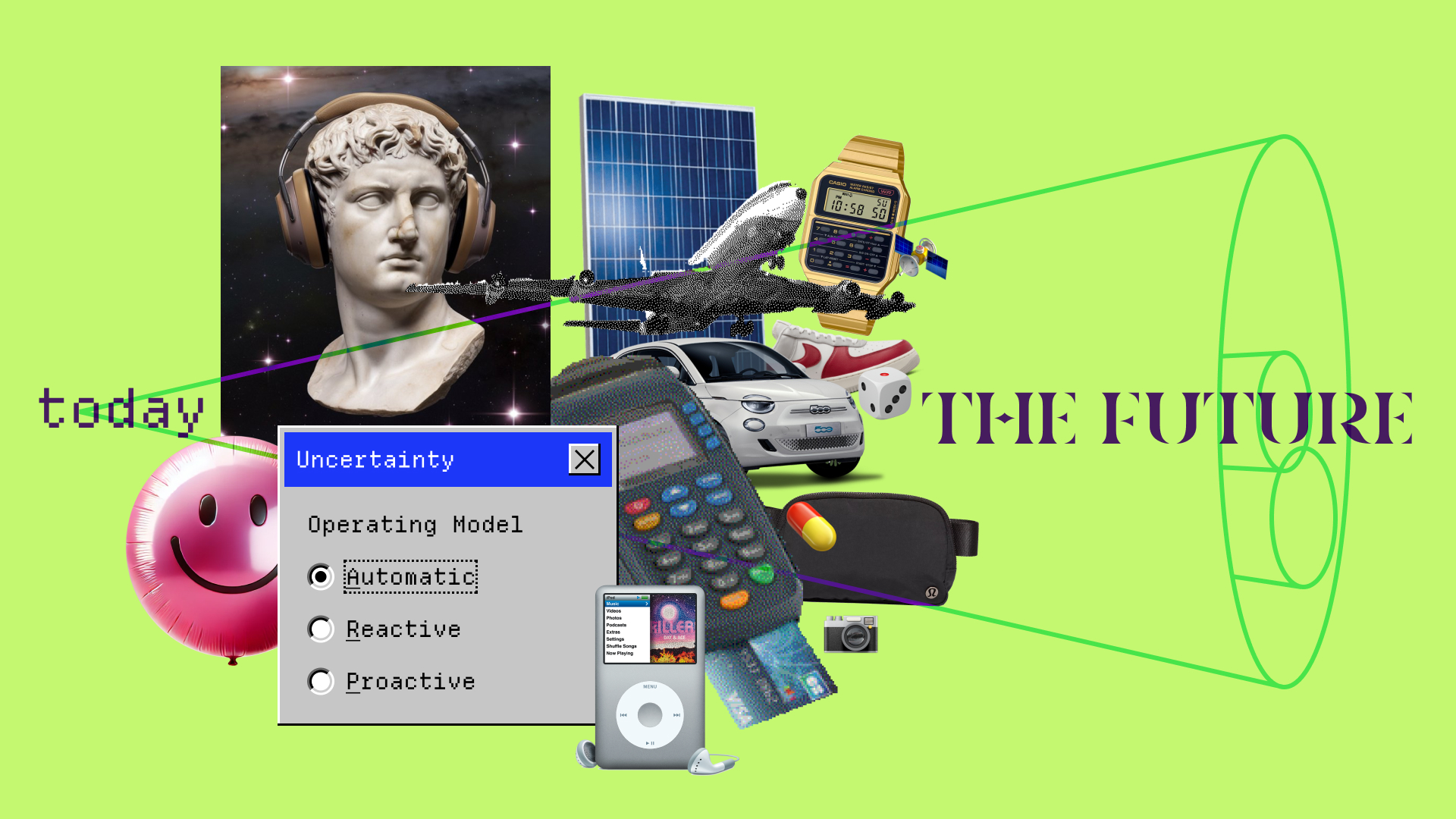
Designing for uncertainty
Hands up ✋ if you’re building something and have no idea what informed the decision to build it. Chances are: you are or have been here. If you’re reading this as a decision maker, this one’s for you.
My entire working life I’ve seen business leaders race to react to market changes. We see something picking up speed and build build build due to FOMO, until we are blindsided by something like unforeseen competition, consumer preference changes, a health crisis, regulatory upheaval and so on. Then we need to react to that disruption. This is troublesome if your business relies on things like growth, capital and market presence. So, pretty much every business.
It’s easy to start these articles with platitudes like the pace of change or something something unprecedented disruption, but things are changing quickly. The rate at which capital has flowed into AI in the past 18 months is nothing short of extraordinary. Investors want in on what could be the most transformational technology of our lifetimes.
I mean, it could end up fizzling out into kitschy chatbots and uncanny generative art. Who knows which way the future might go? You should. Otherwise you are likely building a house on shifting sand.
One of the most valuable assets a business can develop is a forward-thinking culture
Reaction-only businesses flail about needlessly, wasting capital and maneuverability. When you spend your time reacting to market conditions you limit your ability to anticipate and plan for change.
Most businesses operate on path dependency:
- Decisions made early on shape the available future options, often constraining flexibility.
- Once a path is chosen, certain actions, investments, and outcomes reinforce the continuation of that path.
- Over time, it becomes increasingly difficult to pivot away from the path, even when external circumstances shift, due to sunk cost and entrenched practices.
- In extreme cases, organizations can become so locked into a path that alternative options are not seriously considered, leading to strategic inertia.
Businesses with an eye on the future are better equipped to navigate uncertainty and outperform their peers because they’ve invested in understanding not only the present landscape but also the possible futures that might unfold. This is forward thinking, and it enables companies to question assumptions and disrupt path dependancy. Breaking free from strategic tunnel vision requires more than just recognizing its constraints; it demands a deliberate shift in how businesses approach the future.
Enabling your team to take a step back and adopt a forward-thinking approach means shifting your mindset from what is to what if. It means sparking imagination beyond today’s solutions to identify risks and opportunities for tomorrow. It doesn’t mean navel gazing for weeks on end, it means sprinting to uncover what might affect your industry or market to inform strategic decisions. It’s called futures design.
Futures design is about designing with the future in mind (duh) by allowing businesses to plan for a range of potential outcomes. Rather than focusing solely on what is likely to happen, futures design asks What could happen? and What do we want to happen?
This mindset shift allows companies to proactively explore opportunities and challenges that may not be immediately apparent.
Late fees
Back in the late 90’s Netflix anticipated the growing demand for digital content delivery and recognized that the internet would eventually dominate the way people consume entertainment (I mean, come on, they named their company _Net_flix in ‘98). It began transitioning from a DVD rental business to an online streaming platform in the late 00’s as broadband began to become available in the US.
The part everybody knows is this shift allowed Netflix to outmaneuver Blockbuster and other traditional media companies. The part people might not know is the outmaneuvered had boards more focused on squeezing the last vestiges of late fees than this thing called the internet. Terrible foresight.
By 2010, Blockbuster had folded while Netflix began to anticipate headwinds from those same media companies from whom they licensed content. Netflix adopted the HBO strategy and focused on developing original content long before others fully committed to streaming. Today, they’re still the gold standard.
This is an obvious observation about a very large and disruptive American business—a tale told a million times over. But it shows the power of anticipating risk and controlling your future. Futures design isn’t just about planning for disruption; it’s about shaping it. Who or what will be your Netflix?
Designing for uncertainty
I don’t think every company needs full blown foresight capabilities, but every business should encourage a forward thinking culture. To effectively design for uncertainty, your team must be able to think beyond today and kickstart that mindset shift. Here’s a few things we’re exploring and implementing at Koru.
Horizon scanning—essentially, broadening our media diet. Instead of just sticking to the usual feeds, we’ve started to mix in niche blogs, academic papers, news outside of North America, or subcultural social spaces to look for evidence of change in behaviour or new trends just bubbling up on the “horizon.” This is crucial for discouraging that tunnel vision. You can begin by collecting and sharing these stories within your team, encouraging thoughtful discussion and start to build a culture that’s always on the lookout for what’s next. We have a Slack channel called not-interesting which is certainly interesting.
Empowered by insights from scanning and other research, we’re also working with futures design exercises to explore opportunities and risks beyond today. These workshoppable activities push beyond traditional ideation sessions and add forward thinking:
- Future Headlines from 5 or 10 years down the road to spot potential industry shifts.
- SWOT Analysis 203X to figure out what strengths, weaknesses, opportunities, and threats your business might have in a decade.
- Scenario Planning for mapping out different ways the future might unfold.
- Futures Wheel to explore the ripple effects of a big change.
- Artifact from the Future lets you create a prototype of a product or service that might exist in the future, helping you think through its development and potential implications.
Finally, (and your mileage my vary depending on how and where in your initiative you run these) you can use them to inform strategy. This might mean using them to make informed investment decisions—if you see something emerging on the horizon, it might make sense to ramp up R&D in that space. It might also mean uncovering potential risk and developing mitigation strategies so you’re ready to act quickly when challenges pop up. Use them to inform product roadmaps, business models, customer segmentation and more. Plus, these activities can spark innovation and a culture of what if.
Time to shift from reactive to proactive
We are so past a group of executives huddled around a McKinsey report waiting for insights to jump off the page. We can and should take hold of our futures. We should have the gumption to empower our teams to navigate the future like it’s not on rails, but more like a network of highways—anticipating the twists, turns, roadblocks and surprises along the way. Instead of reacting to trends, we should be at the forefront of them. How will your business design for uncertainty?